
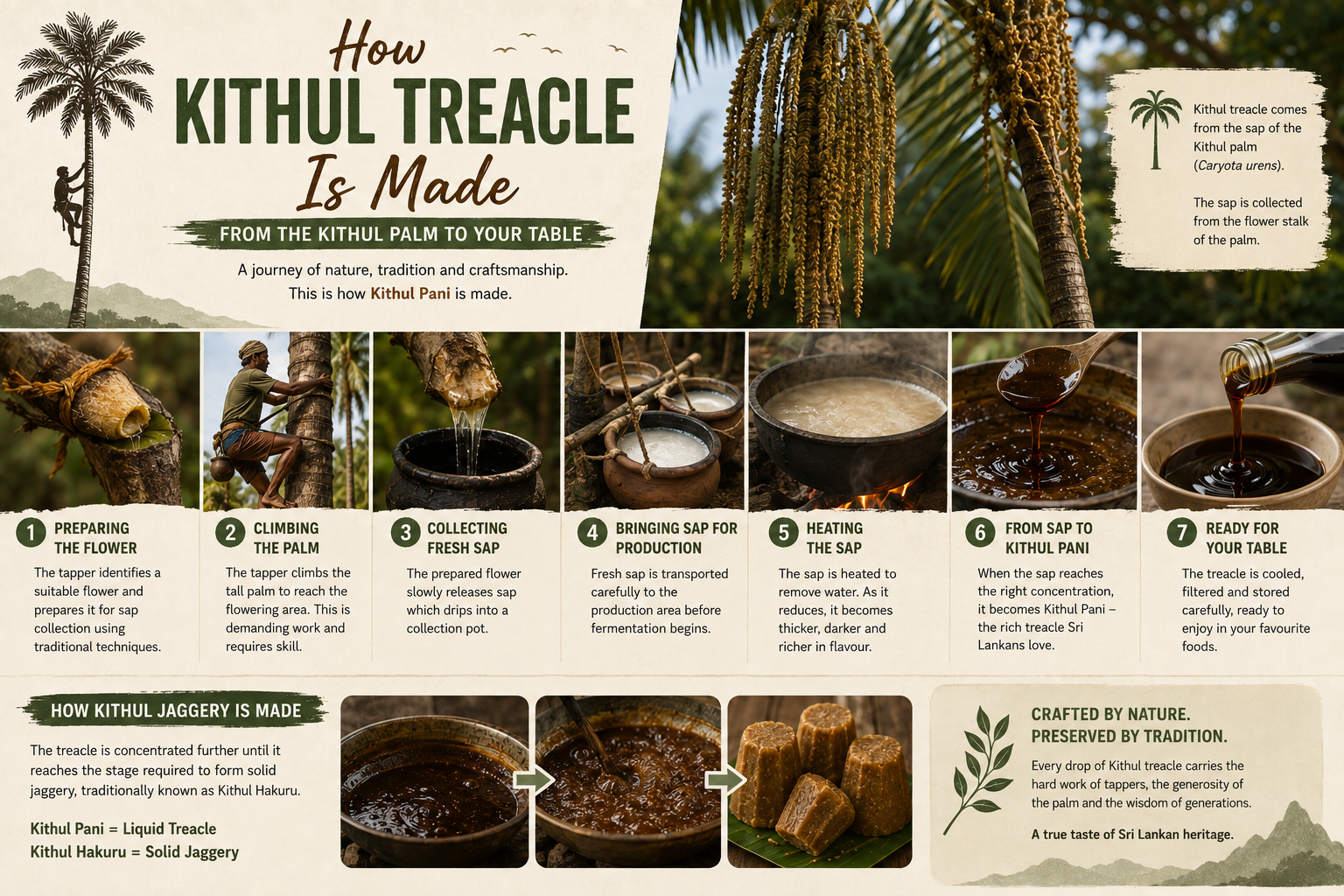
Before Kithul treacle reaches a bottle, its journey begins high above the ground on a Kithul palm.
A skilled tapper climbs the tree, prepares its flower and collects the fresh Kithul sap that slowly flows from it. The sap is then carefully heated and concentrated until it becomes the rich, dark syrup Sri Lankans know as Kithul Pani.
It sounds simple, but authentic Kithul production requires skill, patience and generations of traditional knowledge.
Here’s how Kithul treacle is made, from palm to table.
It All Starts With the Kithul Palm
Kithul treacle comes from the Kithul palm, scientifically known as Caryota urens.
One of its most recognisable features is its unusual fishtail-shaped leaves. Mature palms also produce large hanging flower clusters called inflorescences.
And this is where the treacle-making story really begins.
Unlike maple syrup, which is obtained by tapping the trunk, traditional Kithul production involves collecting sap from the palm’s flower stalk.
The flower must first be carefully prepared by an experienced Kithul tapper.
Step 1: The Kithul Tapper Prepares the Flower
Kithul tapping in Sri Lanka is a specialised traditional skill.
The tapper identifies a suitable flower and prepares it for sap collection using techniques developed through generations of practical experience.
This stage matters because not every flower automatically produces a good flow of sap.
The tapper needs to understand the palm, recognise the right stage of the flower and know how it should be prepared.
Traditional Kithul production therefore begins with something that cannot simply be manufactured in a factory: knowledge of the tree itself.
Step 2: Climbing the Kithul Palm
Then comes one of the most demanding parts of the job.
The tapper has to climb the palm.
Kithul palms can grow tall, so traditional tappers use climbing arrangements attached to or positioned alongside the trunk to reach the flowering area.
They may need to make this journey repeatedly while the palm is being tapped.
It is physically demanding work and one reason the role of the Kithul tapper is so important to the traditional industry.
Without the tapper, there is no Kithul Pani.
Step 3: Collecting Fresh Kithul Sap
Once the flower has been properly prepared, a collection container is positioned beneath the tapping point.
The Kithul sap gradually drips into it.
Fresh sap is relatively thin and looks very different from the dark, thick Kithul syrup you eventually pour from a bottle.
It also needs to be collected and handled properly because fresh palm sap can naturally begin fermenting.
The quality of the raw sap is therefore an important part of producing good Kithul treacle.
Step 4: Bringing the Sap for Production
After collection, the fresh Kithul sap is brought from the tapping area for processing.
Time matters here.
The goal when making treacle is to begin processing the fresh sap before unwanted fermentation changes the raw material.
For producers working directly with local tappers, this part of the supply chain is especially important. Knowing when and where sap was collected provides greater control over the raw material entering production.
Step 5: Heating the Kithul Sap
Now comes the transformation.
Fresh Kithul sap contains a considerable amount of water. To make treacle, it must be heated so that this water gradually evaporates.
As the sap reduces, several things begin to happen.
It becomes:
- thicker
- darker
- sweeter and more concentrated
- increasingly aromatic
This is where the familiar colour, consistency and deep flavour of Sri Lankan treacle begin to develop.
The process needs attention.
If the sap isn’t concentrated enough, the finished treacle may remain too thin. Excessive heating can also affect its flavour and consistency.
Knowing when the treacle has reached the right stage is therefore an important part of traditional Kithul production.
Step 6: From Kithul Sap to Kithul Pani
Once the sap reaches the desired concentration, it has become the product Sri Lankans know and love as Kithul Pani.
Good Kithul treacle has more character than ordinary sugar syrup.
Its flavour can have rich caramel-like, earthy and lightly roasted notes, although natural variation is possible between batches.
That’s because authentic Kithul is an agricultural product.
The palm, sap and processing conditions can all influence the final result.
For many Sri Lankans, the best way to enjoy it requires no complicated recipe at all:
fresh buffalo curd + Kithul Pani.
How Does Kithul Jaggery Fit Into the Process?
Kithul treacle isn’t the only traditional product made from Kithul sap.
The preparation can be concentrated further to produce Kithul jaggery, known locally as Kithul Hakuru.
Instead of remaining a pourable syrup, the concentrated product is formed into the familiar solid jaggery.
So:
Kithul Pani = liquid treacle
Kithul Hakuru = solid jaggery
Both begin with sap collected from the Caryota urens palm.
This is why pure Kithul jaggery and pure Kithul treacle share such a close connection in traditional Sri Lankan food culture.
Why Traditional Kithul Production Matters
Understanding how Kithul treacle is made also helps explain why authenticity matters.
Producing genuine Kithul Pani requires:
a suitable Kithul palm → an experienced tapper → properly prepared flowers → fresh sap → careful collection → controlled heating → proper concentration
There are no shortcuts in that traditional chain.
This also explains why consumers shouldn’t judge pure Kithul treacle only by how dark or thick it looks.
Sri Lankan research has examined Kithul quality and adulteration, including the addition of other sugar sources to Kithul products.
For consumers looking for authentic Kithul, understanding where a product comes from and how it was produced can therefore be more useful than relying on appearance alone.
Kothmale Kithul: Keeping the Journey Close to Home
Around Kothmale, Kithul palms form part of Sri Lanka’s rich hill-country landscape and agricultural heritage.
At Mellow Food Products, this is where our Kithul journey begins.
We work with local Kithul tappers and collect fresh sap directly before managing our production in-house.
That gives us a close connection to the process—from understanding where the sap originated to turning it into the finished Kithul product.
It also means the people behind the product remain an important part of the story.
When consumers support genuinely produced Kothmale Kithul, they are also helping create continued demand for traditional tapping skills and local livelihoods connected to the industry.
Why Authenticity Matters When Buying Kithul
If you’re shopping for Kithul products in Sri Lanka, don’t choose a bottle based solely on colour, thickness or price.
Ask a few simple questions:
- Is the ingredient information clear?
- Where does the Kithul come from?
- Does the producer work directly with tappers?
- Can the producer explain its production process?
- Where is the product actually made?
This is particularly useful when looking for pure Kithul treacle or pure Kithul jaggery.
A trustworthy producer should be able to tell you the story behind what is inside the bottle.
From a Sri Lankan Palm to Your Table
What looks like a simple bottle of Kithul Pani actually represents a surprisingly long journey.
It starts with the Caryota urens palm.
Then comes the tapper who climbs the tree and prepares its flower. The fresh sap is collected, transported and carefully concentrated until it becomes the treacle that eventually reaches your table.
That combination of nature, craftsmanship and traditional knowledge is what makes Kithul one of Sri Lanka’s most distinctive foods.
Whether you pour it over curd, add it to yoghurt, use it in a dessert or enjoy Kithul Hakuru with a cup of tea, you’re experiencing a tradition that begins high in the Sri Lankan Kithul palm.
If you’d like to discover authentic Sri Lankan natural sweetener products made from Kothmale Kithul, explore Mellow Food Products’ traditionally crafted Kithul Treacle and Kithul Jaggery.
Frequently Asked Questions
How is Kithul treacle made?
Kithul treacle is made by collecting sap from the prepared flower of the Kithul palm (Caryota urens) and carefully heating the fresh sap to remove water until it becomes a concentrated syrup known as Kithul Pani.
Where does Kithul sap come from?
Kithul sap is collected from the flower stalk of the Kithul palm rather than simply being extracted from the trunk.
What does a Kithul tapper do?
A Kithul tapper identifies and prepares suitable Kithul flowers, climbs the palms and manages the collection of fresh sap. Traditional Kithul tapping requires specialised knowledge and experience.
Is Kithul treacle the same as Kithul Pani?
Yes. Kithul Pani is the traditional Sri Lankan term commonly used for Kithul treacle. Internationally, it may also be described as Kitul treacle or Kithul syrup.
How is Kithul jaggery made?
Kithul jaggery is also produced from Kithul palm sap. The preparation is concentrated further until it reaches the stage required to form solid jaggery, traditionally called Kithul Hakuru.
How can I identify pure Kithul treacle?
Appearance alone cannot prove purity. Look for clear ingredients, transparent sourcing and a producer who can explain where its Kithul sap comes from and how the product is made.
Where is Kithul treacle made in Sri Lanka?
Kithul products are produced in several parts of Sri Lanka where Kithul palms and traditional tapping communities are found. Kothmale and the surrounding hill-country region have a strong connection with traditional Kithul production.