
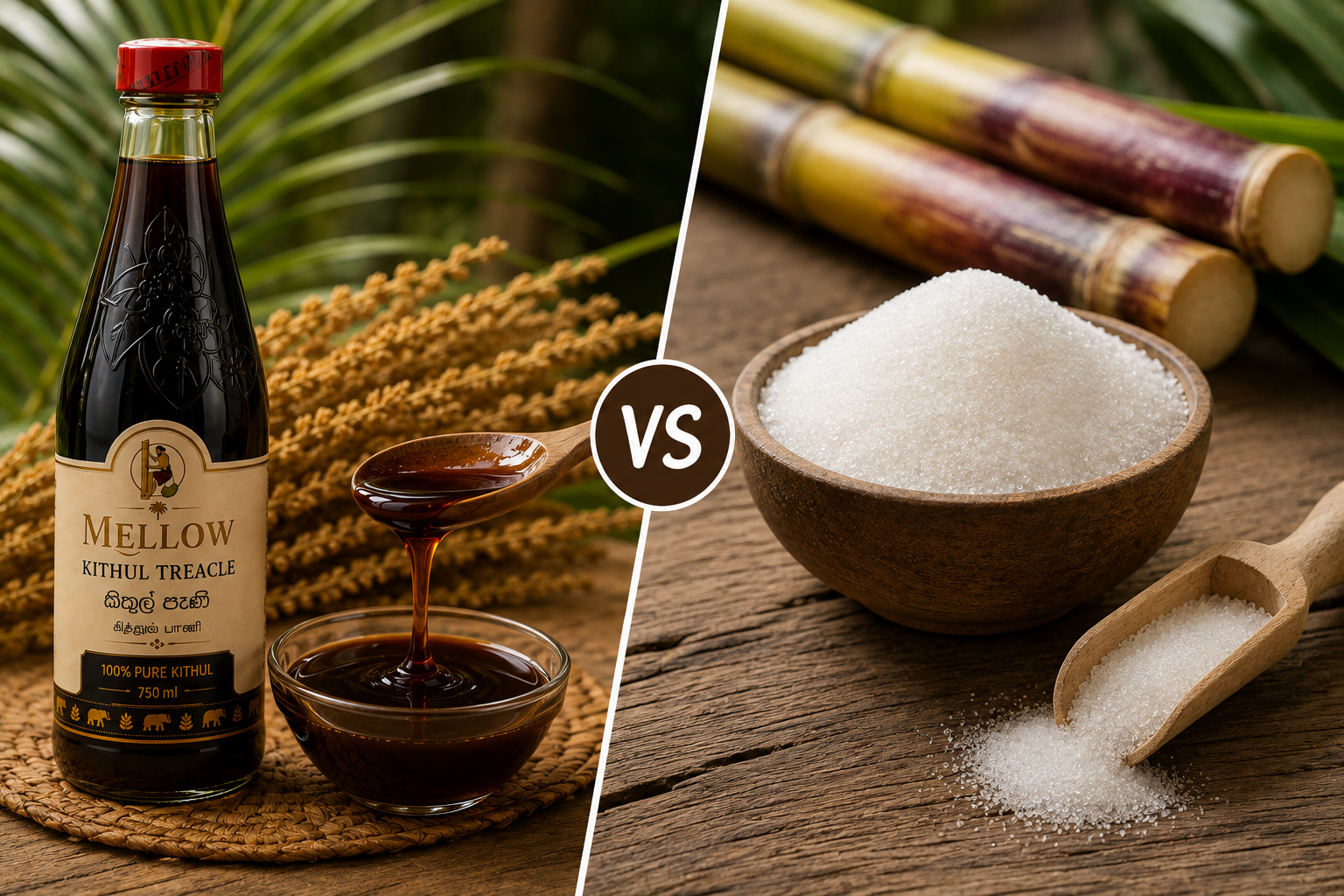
If you’re trying to reduce your reliance on refined white sugar, you may have come across Kithul treacle as a more traditional alternative. But when comparing Kithul treacle vs sugar, is Kithul Pani actually better?
The answer needs some balance. Pure Kithul treacle offers a distinctive flavour, traditional production method and naturally occurring compounds from Kithul palm sap. But it is still a sweetener containing sugars and carbohydrates.
Here’s what you should know before making the switch.
What Is Kithul Treacle?
Kithul treacle, locally known as Kithul Pani, is made from sap collected from the flower of the Kithul palm (Caryota urens).
Skilled Kithul tappers prepare the flower and collect the fresh sap. It is then carefully heated so that water gradually evaporates, producing the rich, dark syrup associated with traditional Kithul treacle in Sri Lanka.
The same Kithul sap can also be further concentrated to produce Kithul jaggery, traditionally called Kithul Hakuru.
White sugar takes a very different journey to your kitchen.
What Is White Sugar?
White table sugar is refined sucrose, commonly produced from sugar cane or sugar beet.
During commercial processing, sugar is extracted and refined before being crystallised into the familiar white granules used in households around the world.
Its main purpose is simple: sweetness.
That is one of the first differences when comparing Kithul syrup vs sugar.
Kithul Pani doesn’t simply add sweetness. It also contributes its own distinctive flavour, aroma and colour to food.
Kithul Treacle vs White Sugar: What’s the Difference?
Here’s a simple comparison.
| Kithul Treacle | White Sugar | |
|---|---|---|
| Source | Sap of the Kithul palm | Usually sugar cane or sugar beet |
| Form | Thick liquid syrup | Crystals |
| Flavour | Rich, caramel-like and distinctive | Clean, neutral sweetness |
| Processing | Sap is collected and concentrated | Extracted, purified and crystallised |
| Traditional Sri Lankan connection | Strong | Common ingredient but not uniquely Sri Lankan |
| Contains sugars | Yes | Yes |
| Best use | Curd, yoghurt, desserts, drinks and cooking | General-purpose sweetening and baking |
Neither product becomes “healthy” simply because of where it comes from.
However, they offer very different experiences.
Does Kithul Treacle Contain Nutrients?
One reason Kithul treacle vs sugar attracts attention is that Kithul comes from palm sap rather than being a purified sugar crystal.
Sri Lankan academic research has examined the composition of Caryota urens sap and Kithul products. Studies and reviews have reported naturally occurring minerals and other compounds in Kithul-derived products.
White table sugar, by comparison, is predominantly sucrose.
However, this difference needs to be kept in perspective.
The presence of naturally occurring compounds does not mean Kithul treacle should be consumed in unlimited amounts or treated as a nutritional supplement.
Kithul Pani is still a sweetener.
What About the Kithul Treacle GI?
This is where a lot of confusing information appears online.
GI, or Glycaemic Index, describes how carbohydrate-containing foods affect blood glucose under standardised testing conditions.
You may see Kithul marketed online as a low GI sweetener in Sri Lanka, sometimes accompanied by very specific GI numbers.
These claims should be approached carefully.
Research has investigated the glycaemic properties of Kithul products, but results can depend on the specific product, composition and testing method. It is therefore not appropriate to assume every bottle of commercially available Kithul treacle has exactly the same GI.
More importantly, a lower glycaemic response does not mean a food is sugar-free.
Kithul treacle contains naturally occurring sugars and carbohydrates.
It should therefore not be described as “safe for diabetics.” Anyone managing diabetes or blood glucose should consider overall carbohydrate intake, portion size and advice from a qualified healthcare professional.
So, Is Kithul Treacle Better Than Sugar?
It depends on what you mean by “better.”
If you’re looking for something with zero sugar, Kithul treacle is not the answer.
If you’re looking for a traditional sweetener with a more complex flavour and a direct connection to Sri Lankan food heritage, the comparison becomes much more interesting.
Pure Kithul Pani can offer:
- a distinctive caramel-like flavour
- a traditional Sri Lankan origin
- naturally occurring components from Kithul palm sap
- versatility in drinks, desserts and breakfast foods
- an alternative to using refined white sugar in certain recipes
Perhaps the biggest advantage is flavour.
A spoonful of white sugar mostly adds sweetness. A small amount of good Kithul syrup can add sweetness, aroma and character at the same time.
Kithul Treacle as a Natural Sugar Alternative in Sri Lanka
Consumers searching for natural sugar alternatives in Sri Lanka will encounter everything from honey and coconut-based sweeteners to Kithul products.
But Kithul has something particularly Sri Lankan about it.
Traditional Kithul tapping relies on skilled tappers who climb the palms and collect sap from prepared flowers. That fresh sap then has to be carefully handled and concentrated.
The result is a Sri Lankan natural sweetener connected to the land, traditional knowledge and rural communities behind its production.
This makes Kithul Pani more than simply another way to sweeten your coffee.
Easy Ways to Replace White Sugar with Kithul Treacle
You don’t necessarily need to remove every spoonful of sugar from your kitchen.
Instead, try using Kithul where its flavour actually improves the food.
Breakfast
Instead of sprinkling white sugar over plain yoghurt or oatmeal, try a small drizzle of Kithul syrup.
It also pairs beautifully with bananas and other fresh fruit.
Coffee
Try a small amount of Kithul Pani instead of sugar in coffee.
Its deeper flavour works particularly well with milk-based coffee.
Pancakes
Forget ordinary sugar syrup.
Drizzle Kithul treacle over pancakes or waffles with banana, coconut or fresh fruit.
Desserts
Kithul works beautifully with ice cream, puddings, cakes and coconut-based desserts.
And, of course, there is one combination that is difficult to beat.
Curd and Kithul Treacle
Fresh buffalo curd with pure Kithul treacle remains one of Sri Lanka’s most iconic desserts.
The slightly sour curd balances the rich sweetness of the Kithul Pani beautifully.
Sometimes traditional Sri Lankan food gets it exactly right.
Why Pure Kithul Treacle Matters
If you’re comparing Kithul treacle with refined sugar, authenticity matters.
Research in Sri Lanka has investigated adulteration of Kithul products, including the addition of other sugar sources.
A product containing significant added sugar syrup would obviously make a Kithul syrup vs sugar comparison less meaningful.
That’s why consumers looking for original Kithul treacle should consider more than colour and thickness.
Check:
- the ingredient information
- where the product comes from
- whether the producer explains its sourcing
- how the Kithul sap is collected
- where the product is manufactured
The same applies when buying pure Kithul jaggery or Kithul Hakuru.
Knowing the producer can tell you much more than simply looking at a dark bottle.
Kothmale Kithul and Mellow Food Products
At Mellow Food Products, our Kithul journey starts around Kothmale, an area closely connected with Sri Lanka’s hill-country agricultural traditions.
We work with local Kithul tappers, collect fresh Kithul sap and manage production in-house.
This connection matters because authentic Kothmale Kithul starts long before treacle reaches the bottle. It begins with the palm, the flower and the skill of the person tapping it.
Our focus is on maintaining that connection while producing authentic Kithul products in Sri Lanka, including Kithul treacle and Kithul jaggery.
The Bottom Line: Kithul Treacle or White Sugar?
Kithul treacle shouldn’t be marketed as a miracle replacement for sugar.
It contains sugars and should still be consumed thoughtfully.
But if you’re choosing between adding ordinary white sugar and adding a traditional sweetener with distinctive flavour, Sri Lankan heritage and a direct connection to Kithul palm sap, pure Kithul treacle offers something white sugar simply cannot.
It’s not just about making food sweeter.
It’s about what that sweetness brings with it.
For those looking to discover authentic Sri Lankan food products, explore Mellow Food Products’ traditionally crafted Kithul Treacle and Kithul Jaggery from Kothmale.
Frequently Asked Questions
Is Kithul treacle better than white sugar?
They are different types of sweeteners. Kithul treacle retains the distinctive flavour and naturally occurring components of Kithul palm sap, while white sugar is predominantly refined sucrose. However, Kithul treacle still contains sugars and should be consumed appropriately.
Is Kithul treacle a low GI sweetener?
Research has investigated the glycaemic characteristics of Kithul products, but consumers should be cautious about applying one GI value to every Kithul treacle product. Kithul Pani still contains carbohydrates and sugars.
Can people with diabetes use Kithul treacle instead of sugar?
Kithul treacle should not automatically be considered “safe for diabetics.” Anyone managing diabetes or blood glucose should seek appropriate professional dietary or medical advice.
Is Kithul treacle natural?
Traditional Kithul treacle is produced by collecting and concentrating sap from the flower of the Caryota urens palm.
Can I replace white sugar with Kithul syrup?
Kithul syrup can replace sugar in many applications, including yoghurt, oatmeal, coffee, smoothies and desserts. Because it is a liquid with a distinctive flavour, it may not work as a direct one-to-one replacement in every baking recipe.
What is the difference between Kithul treacle and Kithul jaggery?
Kithul treacle, or Kithul Pani, is a liquid sweetener. Kithul jaggery, known as Kithul Hakuru, is a solid traditional sweetener made by further concentrating the Kithul preparation.