
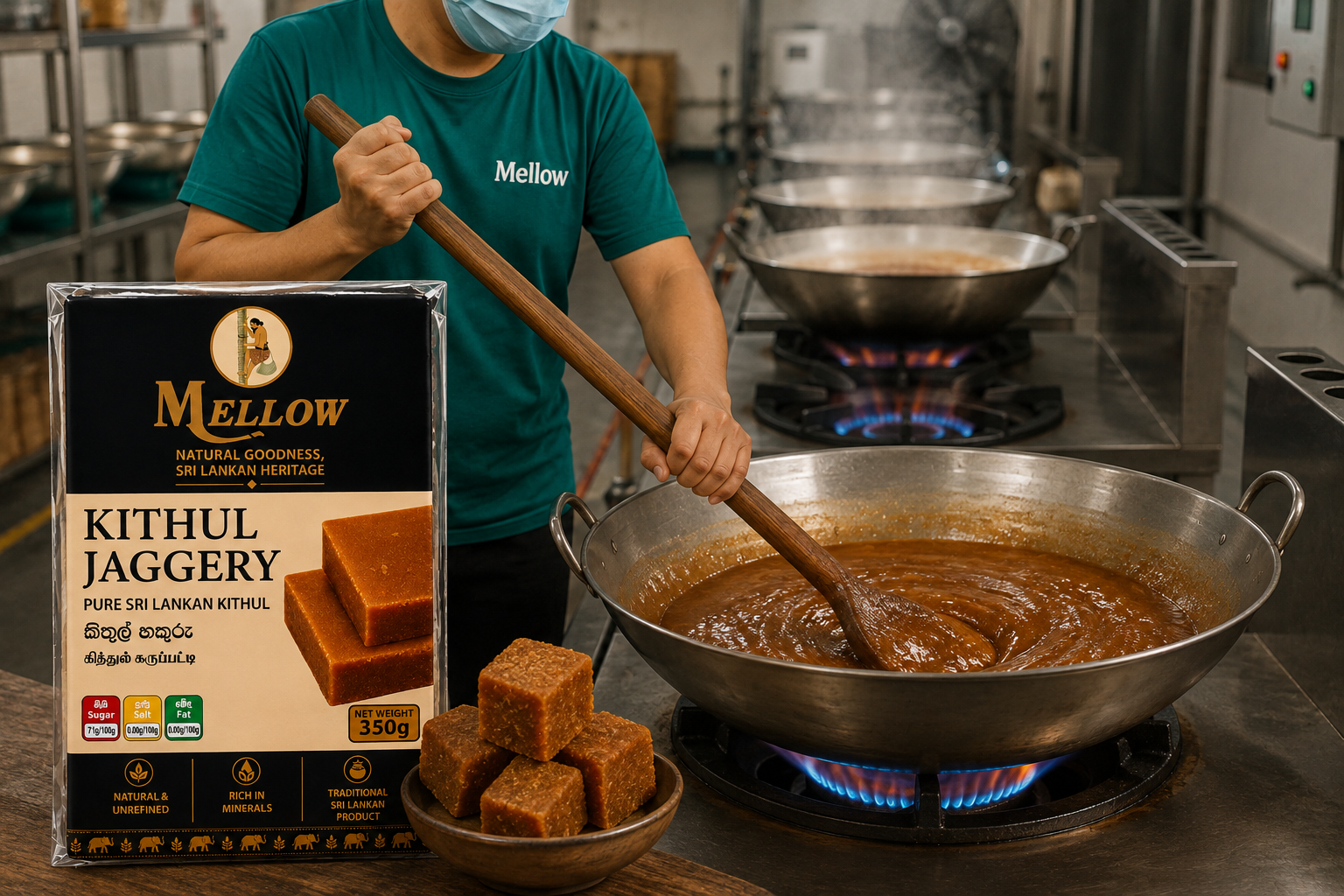
Sweet, rich and deeply connected to Sri Lankan tradition, Kithul jaggery is one of the country’s most distinctive natural sweeteners.
Known locally as Kithul Hakuru, authentic Kithul jaggery is made by collecting sap from the flower of the Kithul palm (Caryota urens), concentrating it through heating and allowing it to set into a solid form.
But what makes Kithul jaggery Sri Lanka so special? To understand that, you need to start with the palm—and the skilled people who tap it.
What Is Kithul Jaggery?
Kithul jaggery is a traditional Sri Lankan sweetener produced from the sap of the Kithul palm.
Unlike refined white sugar, which is crystallised and has a relatively neutral sweetness, Kithul Hakuru has its own distinctive flavour. It can have deep caramel-like, slightly smoky and earthy notes.
For generations, Sri Lankans have enjoyed it with tea, in traditional sweets and as an ingredient in desserts.
The same Kithul sap is also used to make Kithul treacle, known locally as Kithul Pani.
The difference mainly comes down to how far the sap is concentrated.
How Is Kithul Jaggery Made?
Making traditional Sri Lankan jaggery starts long before anything reaches the kitchen.
Step 1: Tapping the Kithul Palm
The process begins with the Caryota urens palm.
A skilled Kithul tapper identifies and prepares a suitable flower of the palm for sap collection.
This is specialised work based on knowledge and experience. Traditional Kithul tapping in Sri Lanka has been practised by rural communities for generations.
Step 2: Collecting Fresh Kithul Sap
After the flower has been prepared, a container is positioned to collect the sap that gradually flows from it.
The fresh Kithul sap is thin and looks very different from finished jaggery.
It must also be handled carefully because fresh palm sap can naturally begin fermenting.
Step 3: Heating and Concentrating the Sap
The collected sap is brought for processing and heated.
As water evaporates, the liquid becomes increasingly concentrated. Its colour darkens, its consistency thickens and its flavour becomes richer.
At one stage, this concentrated sap can become Kithul treacle or Kithul Pani.
To make jaggery, the process continues.
Step 4: Turning Treacle Into Kithul Hakuru
The Kithul preparation is concentrated further until it reaches the consistency needed for jaggery.
It can then be poured into moulds and allowed to cool and set.
The result is the solid traditional sweetener Sri Lankans know as Kithul Hakuru.
So the journey is essentially:
Kithul palm → fresh sap → concentrated sap → Kithul Pani → further concentration → Kithul Hakuru
It’s a simple idea, but producing good Kithul jaggery requires careful control throughout the process.
Kithul Jaggery vs Kithul Treacle
These two traditional products are closely related.
Kithul Treacle (Kithul Pani) is the liquid syrup form. It is ideal for drizzling over food, mixing into drinks and using in desserts.
Kithul Jaggery (Kithul Hakuru) is the solid form. It can be sliced, grated, melted into recipes or simply enjoyed in small pieces.
Both traditionally originate from Kithul palm sap.
If you enjoy the flavour of pure Kithul treacle, Kithul Hakuru offers another way to experience the distinctive taste of the Kithul palm.
What Does Kithul Jaggery Taste Like?
Good Kithul jaggery isn’t simply sweet.
It has a richer flavour than ordinary white sugar, often with caramel-like, earthy and lightly roasted characteristics.
Natural variation can occur between batches.
That’s because genuine Kithul is an agricultural product. The palm, sap and production conditions can all influence the final flavour, colour and texture.
That variation is part of the character of traditionally produced Kithul products.
How to Use Kithul Jaggery
One of the best things about Kithul Hakuru is how easy it is to use.
With a Cup of Tea
This might be the simplest option.
Cut a small piece of Kithul jaggery and enjoy it alongside plain tea instead of adding refined sugar directly to the cup.
The strong tea and rich sweetness work beautifully together.
In Traditional Sri Lankan Desserts
Kithul jaggery can be used in traditional sweets and coconut-based desserts where its deeper flavour complements ingredients such as coconut milk.
It can be grated, chopped or gently melted depending on the recipe.
With Curd
Curd is usually associated with Kithul Pani, but Kithul Hakuru can also work beautifully alongside plain curd.
Grate a little jaggery over the top and let its sweetness contrast with the slightly sour curd.
In Porridge and Oatmeal
Finely grate a small amount over warm oatmeal or porridge.
The heat helps soften the jaggery while adding a caramel-like sweetness.
In Baking
Kithul jaggery can also be experimented with in cakes, cookies and other baked foods.
Remember that jaggery behaves differently from refined sugar, so replacing sugar one-for-one may change the texture, moisture and flavour of a recipe.
Is Kithul Jaggery Healthier Than White Sugar?
This question needs a balanced answer.
Research into Kithul products has identified naturally occurring minerals and bioactive compounds associated with Caryota urens sap and its value-added products.
That makes Kithul compositionally different from highly refined white sugar.
However, Kithul jaggery is still a sweetener containing sugars and carbohydrates.
The presence of naturally occurring compounds doesn’t make it sugar-free or mean it should be eaten without moderation.
Kithul jaggery should also not be described as “safe for diabetics.” Anyone managing diabetes or blood glucose should consider their overall carbohydrate intake and seek appropriate professional dietary or medical advice.
For most consumers, a better reason to choose Kithul Hakuru is its flavour, traditional production and Sri Lankan heritage—not exaggerated health claims.
Why Pure Kithul Jaggery Matters
When shopping for pure Kithul jaggery, authenticity is important.
Traditional production depends on skilled tappers collecting relatively small quantities of sap, followed by careful concentration.
Sri Lankan research has investigated adulteration within the Kithul industry, including the addition of other sugar sources to Kithul products.
This means appearance alone isn’t enough to confirm purity.
When buying Kithul Hakuru, consider:
- the ingredient information
- where the Kithul comes from
- whether the producer explains its sourcing
- how the product is made
- whether the producer works with Kithul tappers
- whether the product is clearly labelled
An unusually dark colour doesn’t automatically mean better quality, just as a particular texture cannot prove that jaggery is pure.
Knowing who made it and where it came from can provide much more useful information.
Kothmale Kithul and Mellow Food Products
At Mellow Food Products, our Kithul journey begins around Kothmale.
We work with local Kithul tappers, collect fresh Kithul sap and manage our production in-house.
That gives us a close connection with the process from the raw sap through to our finished Kithul treacle and Kithul jaggery.
For us, Kithul isn’t simply another sweetener.
It represents the tappers who climb the palms, the knowledge passed through local communities and a traditional Sri Lankan food industry worth preserving.
Our focus is on keeping that connection while producing authentic Kithul products in Sri Lanka for today’s consumers.
More Than Just Something Sweet
In a world filled with highly processed sweeteners, Kithul Hakuru offers something different.
It has a place, a process and a story behind it.
From a Kithul palm growing in Sri Lanka’s hill country to the tapper collecting its sap and the careful production that transforms that sap into jaggery, every piece represents a traditional craft.
Whether you enjoy it with tea, grate it over curd or experiment with it in your favourite dessert, Kithul jaggery is one of the simplest ways to experience an authentic part of Sri Lankan food culture.
If you’d like to discover traditionally crafted Kothmale Kithul, explore Mellow Food Products’ range of authentic Kithul Jaggery and Kithul Treacle.
Frequently Asked Questions
What is Kithul jaggery?
Kithul jaggery is a traditional Sri Lankan solid sweetener made from sap collected from the flower of the Kithul palm (Caryota urens). In Sri Lanka, it is commonly called Kithul Hakuru.
How is Kithul jaggery made?
Fresh Kithul sap is collected and heated to remove water. The liquid is concentrated beyond the treacle stage until it reaches the consistency required for jaggery, then poured into moulds and allowed to set.
What is the difference between Kithul jaggery and Kithul treacle?
Both traditionally originate from Kithul palm sap. Kithul treacle, or Kithul Pani, is a liquid syrup, while Kithul jaggery, or Kithul Hakuru, is the solid form.
How do you eat Kithul Hakuru?
Kithul Hakuru can be enjoyed in small pieces with tea or used in curd, porridge, traditional Sri Lankan desserts and selected baking recipes.
Is Kithul jaggery healthier than sugar?
Kithul jaggery contains naturally occurring components from Kithul palm sap, but it is still a sugar-containing sweetener. It should be consumed appropriately rather than considered an unlimited healthy alternative to sugar.
How can I identify pure Kithul jaggery?
Appearance alone cannot confirm purity. Look at the ingredients, sourcing information and production transparency, and choose a producer who can explain where its Kithul sap comes from and how its jaggery is produced.
What is Kithul Hakuru called in English?
Kithul Hakuru is commonly described in English as Kithul jaggery or Kithul palm jaggery.