
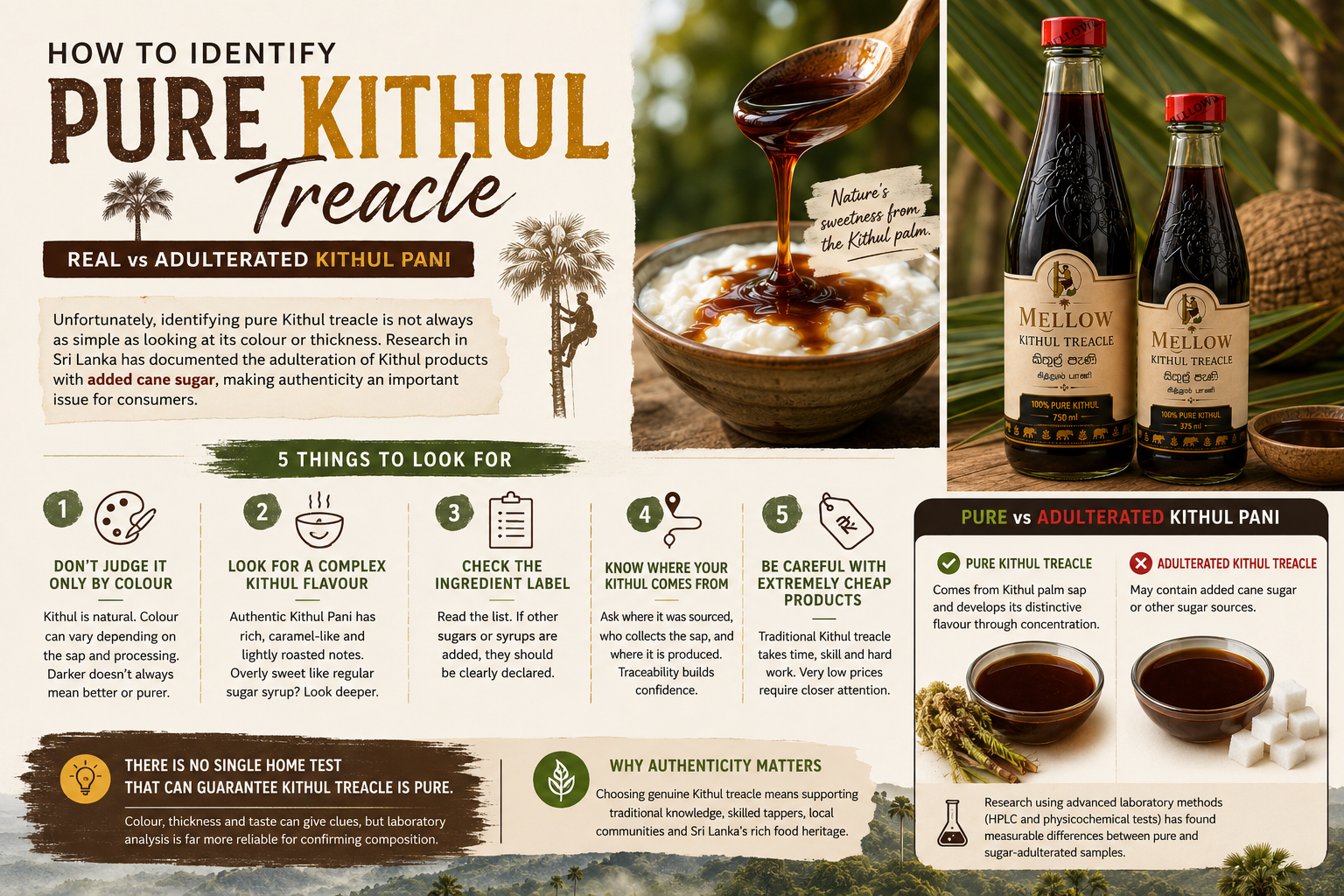
You pick up two bottles of Kithul treacle. Both are dark, both are thick, and both say “Kithul” on the label. But are they both genuine?
Unfortunately, identifying pure Kithul treacle is not always as simple as looking at its colour or thickness. Research in Sri Lanka has documented the adulteration of Kithul products with added cane sugar, making authenticity an important issue for consumers.
So, how can you identify original Kithul treacle? Here is what you should actually look for.
What Is Pure Kithul Treacle?
Pure Kithul treacle, known locally as Kithul Pani, is traditionally produced from the sap collected from the flower of the Kithul palm (Caryota urens).
The fresh sap is carefully heated to remove water. As it concentrates, it develops into the rich syrup Sri Lankans have enjoyed for generations.
Continue concentrating the Kithul preparation further and it can be made into Kithul jaggery, or Kithul Hakuru.
Authentic production sounds simple, but collecting Kithul sap requires skilled tappers, suitable palms, time and careful processing.
That is one reason genuine Kithul products are valuable.
Why Is Kithul Treacle Adulterated?
The traditional Kithul industry depends on a natural raw material, and the amount and quality of sap collected can vary.
A Sri Lankan study involving Kithul tappers across 12 Kithul-growing districts found that sugar adulteration was associated with factors including watery or lower-quality sap and challenges during tapping and production.
Research has also investigated adding table-sugar syrup to Kithul treacle and found measurable differences between pure and adulterated samples.
In simple terms, adding another sugar syrup can increase volume or change sweetness and consistency—but the resulting product is no longer the same as genuine Kithul Pani.
How to Identify Pure Kithul Treacle
Here is the most important thing to understand:
There is no single home test that can guarantee Kithul treacle is pure.
Colour, thickness and taste can give you clues, but laboratory analysis is far more reliable for confirming composition.
Still, there are several things consumers can look for.
1. Don’t Judge It Only by Colour
Many people believe original Kithul treacle must have one particular dark-brown colour.
It isn’t that simple.
Kithul is a natural product. Its appearance can be influenced by the sap and processing conditions, including how much it has been concentrated.
So a darker bottle does not automatically mean better or purer Kithul.
2. Look for a Complex Kithul Flavour
Authentic Sri Lankan treacle is valued for more than sweetness.
Properly produced Kithul Pani can have a rich, distinctive character with caramel-like and lightly roasted notes produced during concentration.
If a product tastes overwhelmingly like ordinary sugar syrup with very little distinctive character, that may give you a reason to look more carefully at the product and its ingredients.
Taste alone, however, cannot prove adulteration.
3. Check the Ingredient Label
This is one of the easiest checks you can make.
Read the ingredient list rather than relying only on the front label.
If you’re specifically looking for pure Kithul treacle, check whether other sweeteners, sugar or syrups are declared.
Clear labelling gives consumers a much better understanding of what they are actually buying.
4. Know Where Your Kithul Comes From
Traceability matters.
Ask simple questions:
Where was the Kithul sourced?
Who collects the sap?
Where is the treacle produced?
Does the producer actually work with Kithul tappers?
For traditional foods such as Kithul Pani, knowing the supply chain can provide greater confidence than choosing a bottle simply because it looks authentic.
5. Be Careful With Extremely Cheap Products
Producing traditional Kithul treacle involves considerable work.
A Kithul tapper must prepare the flower, climb the palm, collect relatively small amounts of fresh sap and continue the process over time. The sap then has to be transported and concentrated to produce treacle.
Price alone cannot prove whether a product is genuine or fake. However, when comparing Kithul products in Sri Lanka, an unusually low price is a reasonable reason to investigate the ingredients and producer more carefully.
Pure vs Adulterated Kithul Pani
The differences are not always visible to the consumer.
Pure Kithul treacle originates from Kithul palm sap and develops its characteristic flavour through concentration.
Adulterated products may contain additional cane sugar or other sugar sources.
Research from Wayamba University of Sri Lanka specifically investigated physicochemical differences between pure Kithul treacle and samples adulterated with table-sugar syrup. The researchers found measurable differences across several parameters.
More recently, researchers from Sri Lanka’s Industrial Technology Institute used High-Performance Liquid Chromatography (HPLC) to examine the sugar profiles of commercially available products labelled as Kithul treacle, highlighting why scientific testing is important when verifying authenticity.
This is why you should be cautious of online tricks claiming you can prove purity simply by shaking, freezing or pouring a bottle.
Why Authentic Kithul Production Matters
Buying authentic Kithul treacle Sri Lanka isn’t only about getting a better-tasting syrup.
Traditional Kithul production supports a much bigger story.
The skills involved in preparing the Caryota urens flower and collecting its sap have been practised by Sri Lankan communities for generations. Research describes the Kithul industry as a traditional agro-based cottage industry in Sri Lanka.
When consumers choose authentic products, they also create demand for the tappers and producers keeping these traditional skills alive.
This is especially important in Kithul-producing areas such as Sri Lanka’s hill country.
Kothmale Kithul: From Tapper to Treacle
At Mellow Food Products, our Kithul story begins around Kothmale.
We work with local Kithul tappers, collect fresh Kithul sap directly and manage our production process in-house.
For us, knowing where the sap comes from is an important part of producing authentic Kothmale Kithul products.
Rather than treating Kithul simply as another sweet flavour, our focus is on maintaining the connection between the Kithul palm, the tapper and the finished product.
That applies to both our Kithul treacle and Kithul jaggery.
What About Pure Kithul Jaggery?
The same authenticity question applies when buying pure Kithul jaggery.
Kithul jaggery, traditionally called Kithul Hakuru, is also produced from Kithul palm sap, but is concentrated further to create its familiar solid form.
When purchasing either treacle or jaggery, look for transparent ingredients, trustworthy sourcing and a producer who can explain how the product is made.
These are some of the best ways to shop more confidently for authentic Sri Lankan food products.
Is Pure Kithul Treacle a Healthy Sugar Replacement?
Kithul is often marketed as a natural sweetener in Sri Lanka, and scientific research has investigated the composition and properties of Kithul products.
But “natural” does not mean sugar-free.
Kithul treacle still contains carbohydrates and naturally occurring sugars and should be consumed accordingly.
Claims that Kithul treacle is automatically “safe for diabetics” should also be treated cautiously. Research into glycaemic properties does not mean a concentrated sweetener can be consumed without considering quantity, diet and individual health circumstances.
The strongest reason to choose genuine Kithul Pani is authenticity—not exaggerated health claims.
Enjoying Genuine Kithul Pani
Once you’ve found good Kithul treacle, sometimes the simplest way to enjoy it is still the best.
Pour a little over fresh Sri Lankan buffalo curd.
You can also try Kithul syrup with yoghurt, fruit, pancakes, oatmeal, ice cream or traditional desserts.
Its distinctive flavour is what makes this Sri Lankan natural sweetener different from ordinary sugar syrup—and why Kithul Pani remains such an important part of traditional Sri Lankan food culture.
When choosing your next bottle, don’t look only for the darkest or cheapest option. Look at the ingredients, producer, sourcing and production story.
If you’d like to experience traditionally crafted Kithul from Kothmale, explore Mellow Food Products’ range of authentic Kithul treacle and Kithul jaggery.
Frequently Asked Questions
How can I identify pure Kithul treacle?
Check the ingredient list, producer, sourcing information and production method. Colour, thickness and taste can provide clues, but they cannot conclusively prove purity.
What is fake Kithul treacle?
The term fake Kithul treacle is commonly used for products presented as Kithul treacle that have been adulterated or substituted with other sugar sources. Scientific analysis is the most reliable way to determine composition.
What colour should pure Kithul treacle be?
There is no single colour that proves purity. Natural Kithul treacle can vary depending on the sap and processing conditions, so darker does not automatically mean purer.
Is Kithul Pani the same as Kithul treacle?
Yes. Kithul Pani is the traditional Sri Lankan name commonly used for Kithul treacle. You may also see it written as Kitul treacle or described as Kithul syrup.
Does pure Kithul treacle contain sugar?
Yes. Kithul palm sap naturally contains sugars, which become concentrated when treacle is produced. “Pure” refers to authenticity and should not be confused with “sugar-free.”
What is the difference between Kithul treacle and Kithul Hakuru?
Kithul treacle is the liquid syrup, while Kithul Hakuru is Kithul jaggery produced as a solid traditional sweetener. Both originate from Kithul palm sap.