
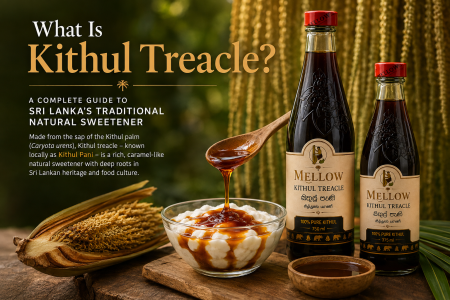
If you have ever enjoyed Sri Lankan curd with a rich, golden-brown syrup on top, you have probably tasted Kithul treacle.
Known locally as Kithul Pani, this traditional Sri Lankan natural sweetener is made from the sap of the Kithul palm (Caryota urens). With its deep caramel-like flavour and long connection to Sri Lankan food culture, Kithul treacle Sri Lanka is becoming increasingly interesting to people looking for authentic, traditionally produced foods.
But what makes real Kithul Pani special? It starts high up in the Kithul palm.
What Is Kithul Treacle?
Kithul treacle, sometimes written as Kitul treacle or called Kithul syrup, is produced by collecting fresh sap from the flower of the Kithul palm.
The Kithul palm, scientifically known as Caryota urens, grows naturally in Sri Lanka and has been used by local communities for generations.
The fresh sap is carefully heated until excess water evaporates, gradually creating the thick, aromatic syrup Sri Lankans know as Kithul Pani.
Unlike refined white sugar, pure Kithul treacle has a distinctive flavour with caramel-like, earthy and slightly smoky notes.
From the Kithul Tree to Your Table
Producing authentic Sri Lankan treacle requires skill, patience and experience.
1. Tapping the Kithul Palm
A skilled Kithul tapper prepares the flower of the Caryota urens palm so that its natural sap can be collected.
Traditional tapping knowledge has been passed through Sri Lankan communities for generations.
2. Collecting Fresh Kithul Sap
The sap slowly flows from the prepared flower into a collection container.
Freshness is important because palm sap can naturally begin fermenting if it is not handled correctly.
3. Making Kithul Pani
The fresh sap is heated and carefully reduced. As water evaporates, the sap becomes darker, thicker and richer in flavour.
The result is the pure Kithul treacle enjoyed across Sri Lanka.
Continue concentrating the preparation further and it can become Kithul jaggery, traditionally known as Kithul Hakuru.
Why Kothmale Kithul Is Special
Sri Lanka’s hill country has a long connection with traditional Kithul production, and Kothmale Kithul forms part of this heritage.
The process is not simply about producing something sweet. It depends on Kithul palms, experienced tappers, fresh sap and careful production.
At Mellow Food Products, our Kithul journey begins around Kothmale. We work with local Kithul tappers, collect fresh Kithul sap and manage production in-house with a focus on authenticity and quality.
This also helps support the communities and traditional knowledge behind one of Sri Lanka’s most distinctive foods.
Why Authenticity Matters
Not every sweet, dark syrup should automatically be considered pure Kithul treacle.
Authentic Kithul production takes considerable time and skill, beginning with the collection of sap directly from Kithul flowers. Sri Lankan academic research has also investigated Kithul treacle quality and methods of identifying adulteration.
When buying Kithul products in Sri Lanka, don’t judge quality only by colour or thickness.
Look for producers who can explain:
- where their Kithul comes from
- how the sap is collected
- how the treacle is produced
- what ingredients are used
- where the product is made
For consumers searching for pure Kithul treacle or pure Kithul jaggery, knowing the producer and production process can be just as important as reading the label.
Kithul Treacle vs Kithul Jaggery
They come from the same traditional source but are enjoyed differently.
Kithul Treacle (Kithul Pani) is the liquid form. It is perfect for drizzling, desserts, drinks and cooking.
Kithul Jaggery (Kithul Hakuru) is the solid form created by further concentrating the Kithul preparation.
Both are among the best-known authentic Sri Lankan food products made from the Kithul palm.
The Classic Sri Lankan Combination: Curd & Kithul
There is probably no better introduction to Kithul Pani than a bowl of fresh buffalo curd topped with Kithul treacle.
The slightly sour curd and rich sweetness of the treacle create one of Sri Lanka’s simplest and most iconic desserts.
But Kithul syrup can do much more.
Try it with:
- yoghurt and fruit
- pancakes or waffles
- oatmeal
- ice cream
- smoothies
- coffee
- coconut desserts
- cakes and puddings
It can also be used when you want a Sri Lankan natural sweetener with more flavour and character than ordinary sugar syrup.
Is Kithul Treacle Healthier Than Sugar?
Kithul products have been studied for their nutritional composition, including naturally occurring minerals and other compounds found in Kithul sap and its products.
However, it is important not to exaggerate these findings.
Kithul treacle is still a sweetener containing naturally occurring carbohydrates and sugars. It should be enjoyed in appropriate quantities as part of a balanced diet.
It should also not be described as “safe for diabetics.” Although research has investigated the glycaemic properties of Kithul products, anyone managing diabetes or blood glucose should seek appropriate professional dietary or medical advice.
The real value of Kithul treacle is not a miracle health claim. It is its unique flavour, traditional production and connection to Sri Lankan heritage.
A Taste of Sri Lankan Heritage
For generations, Kithul tappers have transformed sap from the Caryota urens palm into two of Sri Lanka’s most distinctive traditional foods: Kithul Pani and Kithul Hakuru.
Today, these products represent something bigger than sweetness. They represent traditional knowledge, rural communities and an important part of traditional Sri Lankan food culture.
At Mellow Food Products, we aim to continue that story by producing authentic Kithul products using sap sourced through local Kithul tappers around Kothmale.
If you’re looking to experience authentic Kithul treacle Sri Lanka, explore Mellow Food Products’ range of Kithul treacle, Kithul jaggery and traditional Sri Lankan food products.
Frequently Asked Questions
What is Kithul treacle made from?
Kithul treacle is made by collecting and concentrating sap from the flower of the Kithul palm (Caryota urens).
Is Kithul Pani the same as Kithul treacle?
Yes. Kithul Pani is the commonly used Sri Lankan name for Kithul treacle. It may also be called Kitul treacle or Kithul syrup internationally.
What is Kithul Hakuru?
Kithul Hakuru is Kithul jaggery, the solid traditional sweetener produced from Kithul sap.
What does pure Kithul treacle taste like?
Pure Kithul treacle has a rich sweetness with distinctive caramel-like, earthy and sometimes lightly smoky notes.
How do you use Kithul treacle?
The traditional Sri Lankan favourite is curd and Kithul treacle, but it can also be enjoyed with yoghurt, pancakes, fruit, oatmeal, ice cream, drinks and desserts.
Where can I buy Kithul treacle in Sri Lanka?
Kithul products are available from producers and retailers throughout Sri Lanka. When choosing one, look for clear information about ingredients, sourcing and production. Mellow Food Products produces authentic Kithul products using sap sourced through local Kithul tappers around Kothmale.